In the field of commercial kitchen automation, the real-time collection, accurate transmission, and centralized management of weighing data are core links to ensure the precision of ingredient proportioning, production efficiency, and product consistency. A leading Spanish manufacturer of commercial kitchen automation equipment (specializing in the R&D of intelligent mixing systems and automatic sauce proportioning equipment, with products covering European and South American markets) previously faced challenges such as difficult production traceability and large proportioning errors due to the inability to efficiently connect weighing data to computer systems. After introducing the LD360 Rail-Mounted Weighing Indicator with EtherNet/IP interface and Modbus-TCP protocol support, the company successfully connected the entire chain of weighing data from collection to management, achieving digital upgrading of production processes.
The customer’s core products are commercial intelligent sauce proportioning production lines and automatic dough mixing equipment. Each piece of equipment needs to simultaneously collect weighing data of ingredients (such as flour, oil, and additives) from 3 to 4 weighing stations and upload it to the central computer system in real time for production monitoring, recipe optimization, and data traceability. However, the original weighing solution had three key bottlenecks, which seriously affected production efficiency and product quality:
1:Insufficient Data Precision and Severe Environmental Interference:
Electromagnetic interference generated by motors and frequency converters in the kitchen environment caused frequent data fluctuations in the original pointer-type indicators, resulting in a weighing error of up to ±5%—far exceeding the ±1% precision requirement for food production. Additionally, the low resolution of the display made it difficult for operators to quickly read key data with two decimal places, easily leading to ingredient proportioning deviations.
2:Broken Communication Links and Reliance on Manual Recording:
The original indicators only supported basic RS232 serial communication and could not be directly connected to the customer’s industrial Ethernet computer system. Manual data reading and entry into the database were required at regular intervals, consuming 3 person-hours per day for a single production line. This was not only time-consuming and labor-intensive but also prone to data entry errors and omissions due to human negligence, resulting in low production traceability efficiency.
3:High Expansion Costs and Long Commissioning Cycles for New Lines:
The customer planned to add 3 new production lines annually, but the original indicators required additional driver development to adapt to the computer system. The communication commissioning cycle for a single production line was as long as 2 weeks, with high hardware and software development costs, seriously restricting capacity expansion.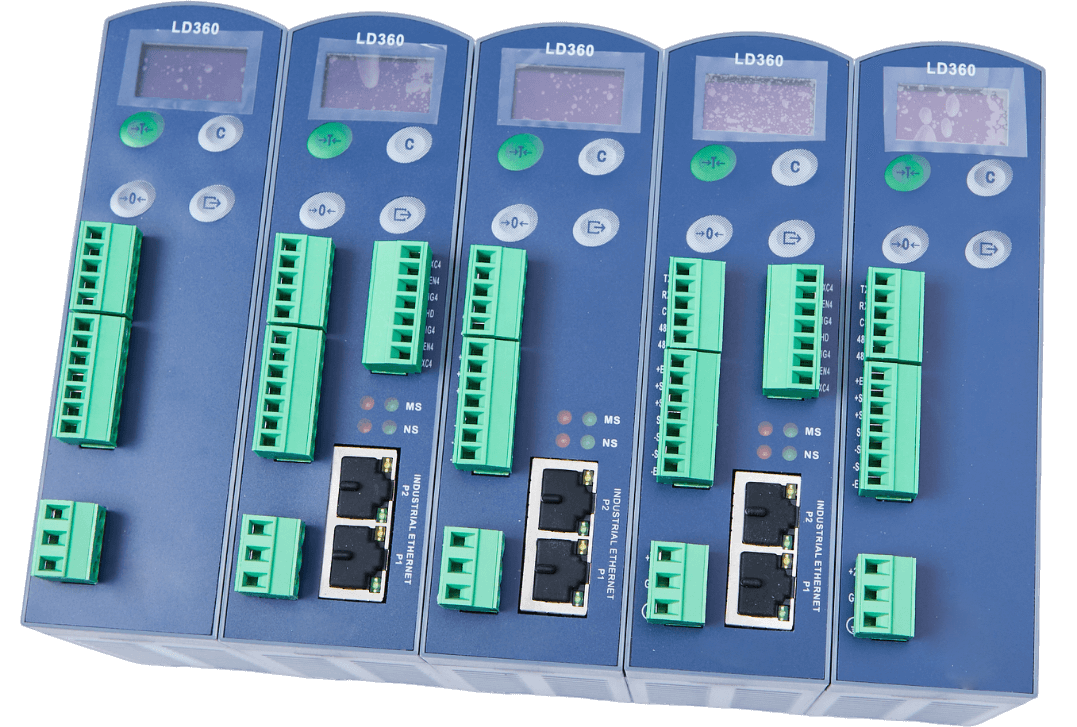
To address the customer’s core needs of “high-precision data collection, direct computer connection and transmission, and low-cost expansion”, we customized a solution centered on the LD360 Rail-Mounted Weighing Indicator. Through optimized hardware configuration and protocol adaptation, the problems of data transmission and management were completely solved:
High-Precision Collection + Strong Anti-Interference to Ensure Data Accuracy
Hardware Precision Advantages: The LD360 has an accuracy class of Class 3 and a 24-bit A/D resolution, supporting a display resolution of 1000-100000. It can clearly present weighing data with 3 decimal places (e.g., 2.500 kg), fully meeting the needs of fine ingredient proportioning. Each analog weighing platform supports up to 8 350Ω sensors, and a single indicator can cover 4 weighing stations, adapting to the simultaneous weighing scenario of multiple stations in the customer’s equipment.
Anti-Interference Design: The indicator is equipped with a built-in digital filter (with adjustable filter coefficients from Level 1 to Level 9) and has passed IEC 61000-4 series anti-interference tests (ESD, EFT, and surge all reaching Level III). It can effectively filter electromagnetic interference in the kitchen, improving data stability to 99.98% and controlling weighing errors within ±0.3%, significantly reducing fluctuations in product quality.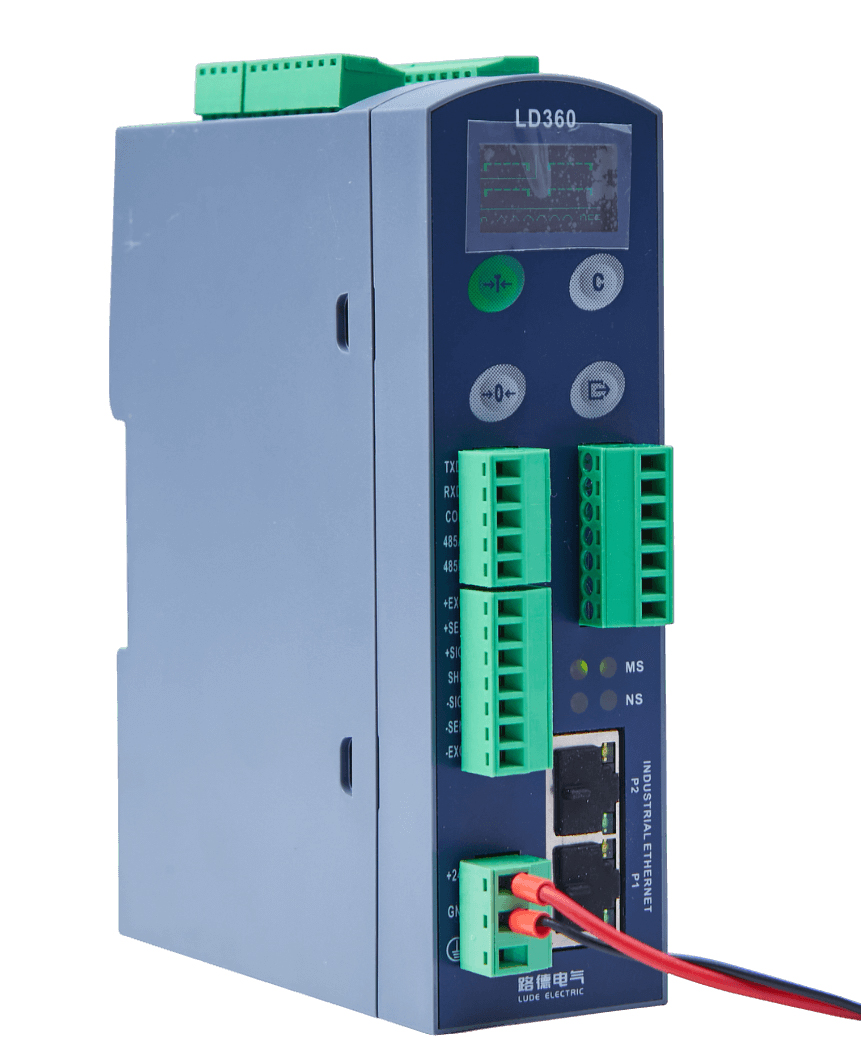
Seamless Connection to Computers for Real-Time Data Transmission
Protocol and Interface Adaptation: The LD360 is configured with an EtherNet/IP industrial Ethernet option board and directly connects to the customer’s industrial Ethernet computer system via the Modbus-TCP protocol (default port 502) without the need for a third-party gateway for conversion. The data transmission rate reaches 100 Mbps, with a delay controlled within 0.05 seconds, realizing “real-time upload upon collection” of weighing data and completely replacing manual recording.
Data Format Compatibility: Through the LD360 parameter setting menu, weighing data can be configured as floating-point (with 3 decimal places retained) or long integer, which is fully compatible with the data format of the customer’s computer database, eliminating the need for additional data conversion. It also supports a “multi-master multi-slave” communication mode, allowing a single computer to connect to up to 32 LD360 indicators simultaneously, enabling real-time reception of weighing data from all stations and accurate matching of recipe requirements for each station.
Anti-Interference Design: The indicator is equipped with a built-in digital filter (with adjustable filter coefficients from Level 1 to Level 9) and has passed IEC 61000-4 series anti-interference tests (ESD, EFT, and surge all reaching Level III). It can effectively filter electromagnetic interference in the kitchen, improving data stability to 99.98% and controlling weighing errors within ±0.3%, significantly reducing fluctuations in product quality.
Protocol and Interface Adaptation: The LD360 is configured with an EtherNet/IP industrial Ethernet option board and directly connects to the customer’s industrial Ethernet computer system via the Modbus-TCP protocol (default port 502) without the need for a third-party gateway for conversion. The data transmission rate reaches 100 Mbps, with a delay controlled within 0.05 seconds, realizing “real-time upload upon collection” of weighing data and completely replacing manual recording.
Modular Design + Convenient Commissioning to Reduce Expansion Costs
Rapid Installation and Deployment:
The LD360 adopts standard 35mm rail-mounted installation, with an outer shell size of only 40mm × 135.5mm × 100mm, which can be directly embedded in the customer’s equipment control cabinet. The installation time is reduced from the original 1 week to 2 hours. The EtherNet/IP option board features a modular design, and only the corresponding board needs to be added when expanding production lines, eliminating the need for re-modification of the equipment structure.
Remote Commissioning and Configuration:
The IP address, node number, and data transmission parameters of the LD360 can be remotely set through the computer system (e.g., DHCP for automatic IP acquisition to be in the same network segment as the existing system). The communication commissioning time for a single indicator is reduced from 4 hours to 30 minutes, and the overall commissioning cycle for a new production line is shortened from 2 weeks to 3 days, with hardware and software costs reduced by 40%.
Usability Optimization to Lower Maintenance Thresholds
Local and Remote Dual Monitoring:
The LD360 is equipped with a 0.96-inch green OLED display, supporting Chinese and English menu switching. Operators can quickly view weighing data and communication status locally (the EtherNet/IP connection status is indicated by red and green LED lights: steady green = normal, flashing red = disconnected). At the same time, the computer system can remotely view the indicator’s operating data (e.g., internal code value, output status) without on-site inspection, reducing maintenance costs.
Calibration-Free Function and Fault Self-Diagnosis:
After a sensor failure and replacement, the LD360’s calibration-free function enables rapid restoration of accurate weighing—there is no need to unload ingredients from the tank; simply enter the sensor sensitivity and complete zero-point calibration, and production can be resumed within 30 minutes. The indicator also supports input/output port testing and internal code value checking, facilitating quick troubleshooting (e.g., loose sensor wiring, abnormal output ports).
Customer Application Results: Dual Leap in Production Efficiency and Quality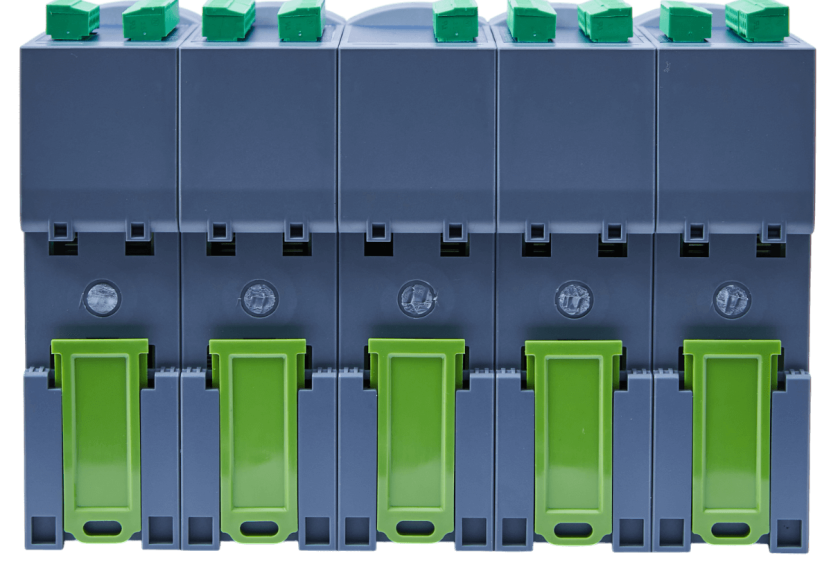
Since the first batch of 80 LD360 indicators was put into use in early 2024, the customer’s production lines have achieved a “qualitative leap” with the following key results:
1:35% Increase in Production Efficiency: Automatic data transmission replaced manual recording, saving 2.5 person-hours per day for a single production line. Three production lines save over 150,000 Euros in labor costs annually. The commissioning cycle for new production lines was shortened by 85%, and the 3 new production lines added in 2024 were put into operation one month ahead of schedule, with an expected annual increase in output value of over 2 million Euros.
2:Significant Improvement in Product Quality: Thanks to the high precision and strong anti-interference capability of the LD360, the ingredient proportioning error was reduced from ±5% to ±0.3%. The customer’s product quality complaint rate decreased by 70%, and the repurchase rate increased by 18%. Meanwhile, the real-time traceability function of weighing data helped the customer quickly comply with EU food production traceability regulations, successfully expanding into the Nordic market.
3:Upgraded Digital Management Capabilities: After weighing data was connected to the computer system in real time, the customer could optimize ingredient usage through data analysis, reducing ingredient waste per batch by 4% and saving over 100,000 Euros in raw material costs annually. Additionally, recipes could be optimized based on historical data, shortening the new product development cycle by 20%.
The customer’s Technical Director commented: “The LD360 not only solved the long-standing data transmission problems we faced but also provided key support for the intelligent upgrading of our equipment with its high precision and convenient expandability. In the future, all our newly manufactured automation equipment will be fully equipped with the LD360 indicator as a standard configuration.”
For scenarios such as food processing and kitchen automation that have high requirements for weighing precision, communication compatibility, and environmental adaptability, the LD360 has particularly prominent core advantages:
From single weighing data collection to full-process digital management, the LD360, with its precise, stable, and flexible features, provides enterprises in the kitchen automation field with a “easy-to-implement and high-return” weighing solution, helping them accelerate automation and digital upgrading.
